About the Journal
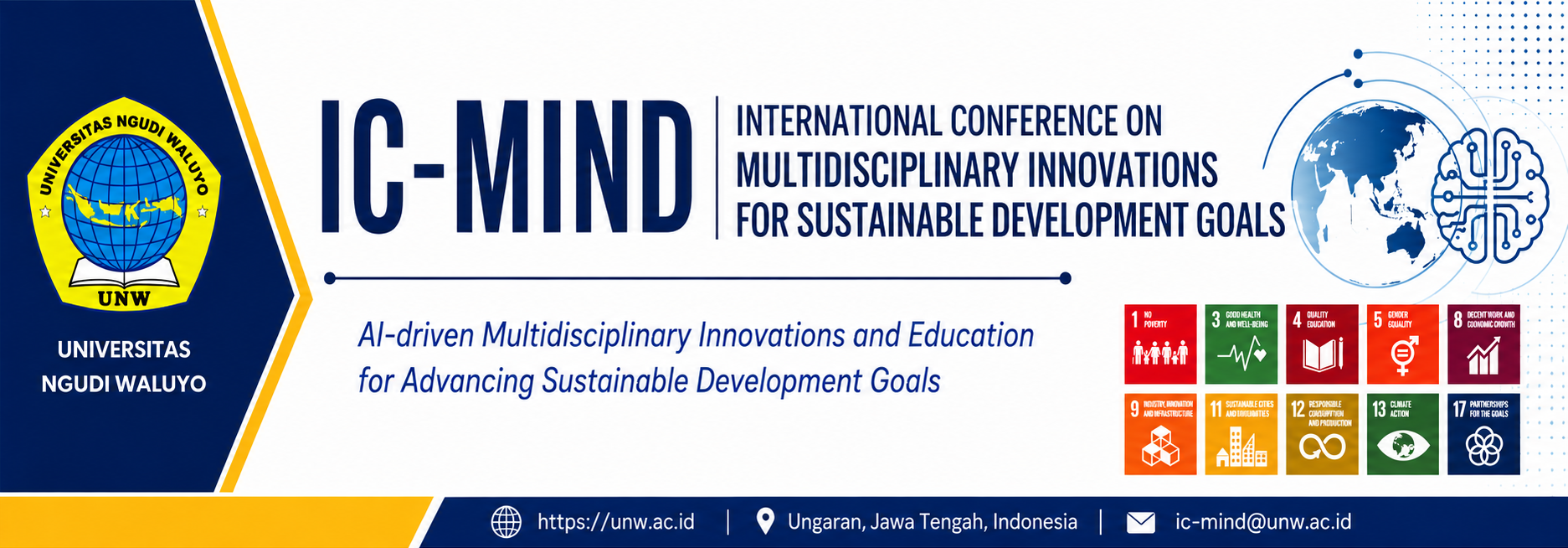
International Conference on Multidisciplinary Innovations for Sustainable Development Goals (IC-MIND)
International Conference on Multidisciplinary Innovations for Sustainable Development Goals (IC-MIND) is an international scientific forum dedicated to disseminating research findings, scientific studies, technological innovations, and multidisciplinary knowledge that contribute to the achievement of the Sustainable Development Goals (SDGs).
IC-MIND provides a platform for academics, researchers, practitioners, professionals, students, policymakers, and other stakeholders from various disciplines to exchange knowledge, share innovative ideas, and establish research collaborations. The conference encourages interdisciplinary approaches to address complex global and local challenges through the integration of science, technology, education, artificial intelligence, social sciences, health, economics, environmental sustainability, and other relevant fields.
IC-MIND places particular emphasis on the development and application of Artificial Intelligence (AI), digital technologies, and multidisciplinary innovations as strategic instruments for advancing sustainable development. Research and innovations presented through IC-MIND are expected to provide both academic contributions and practical solutions that can create meaningful impacts for society.
The conference is aligned with the theme:
“AI-driven Multidisciplinary Innovations and Education for Advancing Sustainable Development Goals.”
This theme reflects the importance of integrating artificial intelligence, multidisciplinary research, and educational innovation to address emerging challenges and accelerate progress toward sustainable development.
Focus and Scope
IC-MIND welcomes original research papers, research-based innovations, case studies, conceptual studies, methodological developments, technology implementations, and interdisciplinary research covering, but not limited to, the following areas:
1. Artificial Intelligence and Machine Learning
- Artificial Intelligence
- Machine Learning
- Deep Learning
- Generative AI
- Natural Language Processing
- Computer Vision
- Data Mining and Data Science
- Predictive Analytics
- Explainable AI
- Responsible and Ethical AI
- AI Applications in Various Domains
2. Computer Science and Information Technology
- Information Systems
- Software Engineering
- Computer Networks
- Cybersecurity
- Internet of Things
- Cloud Computing
- Big Data
- Digital Transformation
- Human-Computer Interaction
- Emerging Digital Technologies
3. Education and Educational Technology
- Artificial Intelligence in Education
- E-Learning
- Blended Learning
- Digital Learning
- Learning Analytics
- Educational Technology
- Innovative Learning Models
- Digital Pedagogy
- Technology-Enhanced Learning
- Digital Literacy
- Competency-Based and Future-Oriented Education
4. Multidisciplinary Innovation
- Interdisciplinary Research
- Technology-Based Innovation
- Social Innovation
- Business and Economic Innovation
- Health Innovation
- Community Development
- Digital Society
- Smart Community
- Innovation Management
5. Health and Well-Being
- Digital Health
- Health Informatics
- Artificial Intelligence in Healthcare
- Public Health
- Health Technology
- Healthcare Management
- Preventive and Community Health
- Data-Driven Healthcare
6. Sustainable Development and Environment
- Environmental Sustainability
- Green Technology
- Climate Change
- Renewable Energy
- Sustainable Agriculture
- Sustainable Cities and Communities
- Environmental Management
- Circular Economy
- Natural Resource Management
7. Social Sciences, Economics, and Business
- Digital Economy
- Sustainable Business
- Entrepreneurship
- Financial Technology
- Business Intelligence
- Economic Development
- Social Innovation
- Public Policy
- Community Empowerment
- Inclusive Development
8. Sustainable Development Goals (SDGs)
IC-MIND welcomes research addressing one or more of the 17 Sustainable Development Goals, including:
- No Poverty
- Zero Hunger
- Good Health and Well-Being
- Quality Education
- Gender Equality
- Clean Water and Sanitation
- Affordable and Clean Energy
- Decent Work and Economic Growth
- Industry, Innovation and Infrastructure
- Reduced Inequalities
- Sustainable Cities and Communities
- Responsible Consumption and Production
- Climate Action
- Life Below Water
- Life on Land
- Peace, Justice and Strong Institutions
- Partnerships for the Goals
Publication Policy
IC-MIND accepts scholarly contributions that meet the academic and scientific standards established by the conference. All submitted manuscripts are subject to an appropriate peer-review and editorial process to ensure the quality, originality, relevance, and scientific integrity of published works.
Submissions should present original contributions and should not have been previously published or simultaneously submitted for publication elsewhere. Authors are responsible for ensuring the accuracy, originality, ethical compliance, and proper citation of all content contained in their manuscripts.
IC-MIND encourages authors to present research that demonstrates clear methodological rigor, meaningful findings, and relevance to multidisciplinary innovation and sustainable development.
Multidisciplinary and International Collaboration
IC-MIND is committed to strengthening international and multidisciplinary research collaboration. By bringing together researchers and practitioners from different academic and professional backgrounds, the conference seeks to facilitate knowledge exchange and the development of collaborative solutions to complex societal challenges.
The conference particularly encourages research collaborations that integrate AI, digital transformation, education, science, technology, health, social sciences, economics, and environmental sustainability.
Contribution to Sustainable Development
IC-MIND recognizes that achieving the SDGs requires collaboration across disciplines and sectors. Therefore, research presented through IC-MIND is encouraged to clearly demonstrate its potential contribution to one or more SDG targets.
The conference promotes research that is:
- Innovative, by introducing new ideas, methods, technologies, or approaches;
- Multidisciplinary, by integrating knowledge from different fields;
- Evidence-based, by applying rigorous research methodologies;
- Applicable, by providing practical solutions to real-world problems;
- Inclusive, by considering diverse communities and stakeholders;
- Sustainable, by addressing long-term social, economic, and environmental impacts; and
- Impact-oriented, by contributing to measurable improvements in society and sustainable development.
Ethics and Research Integrity
IC-MIND is committed to maintaining high standards of academic integrity, research ethics, and responsible scholarly communication. Authors, reviewers, editors, and conference organizers are expected to uphold principles of honesty, transparency, originality, accountability, and respect for intellectual property.
Manuscripts involving human participants, personal data, health information, or other sensitive research materials should comply with applicable ethical standards and regulations.
IC-MIND does not tolerate plagiarism, duplicate publication, fabrication, falsification, manipulation of research results, or other forms of academic misconduct.
Open Knowledge and Dissemination
IC-MIND supports the broad dissemination of scientific knowledge and encourages authors to share research findings that can benefit the academic community, industry, government, and society.
Through the publication and dissemination of high-quality multidisciplinary research, IC-MIND aims to contribute to the advancement of science and technology while supporting evidence-based solutions for sustainable development.
Our Vision
To become an internationally recognized multidisciplinary scientific forum that advances innovative, responsible, and sustainable solutions through the integration of Artificial Intelligence, education, science, technology, and cross-disciplinary collaboration.
Our Mission
- To provide an international platform for disseminating high-quality multidisciplinary research and innovation.
- To promote collaboration among researchers, academics, practitioners, industry, government, and other stakeholders.
- To encourage the responsible development and application of Artificial Intelligence and emerging technologies.
- To support educational innovation and digital transformation.
- To facilitate research that contributes directly or indirectly to the achievement of the Sustainable Development Goals.
- To strengthen international research networks and interdisciplinary collaboration.
- To promote research outcomes that generate meaningful academic, technological, social, economic, and environmental impacts.
Through these commitments, International Conference on Multidisciplinary Innovations for Sustainable Development Goals (IC-MIND) seeks to serve as a bridge between multidisciplinary scientific research, technological innovation, education, and sustainable development, contributing to solutions for a better and more sustainable future.